Home Treatments Laser Hair Removal HydroFacial O2 HIFU Skin Tightening Fat Freezing Microneedling View all treatments → Browse by concern About Us Blog Book Consultation
Clinical Microneedling · Qualified Specialist

Real skin concerns.
Clinical answers.

For acne scars · Fine lines · Pigmentation · Large pores · Stretch marks · Uneven texture · Surgical scars · Hair thinning

Qualified Specialist
Texture & Scarring
Clinical Grade
1, 4 & 6-Session Programmes
Free Consultation
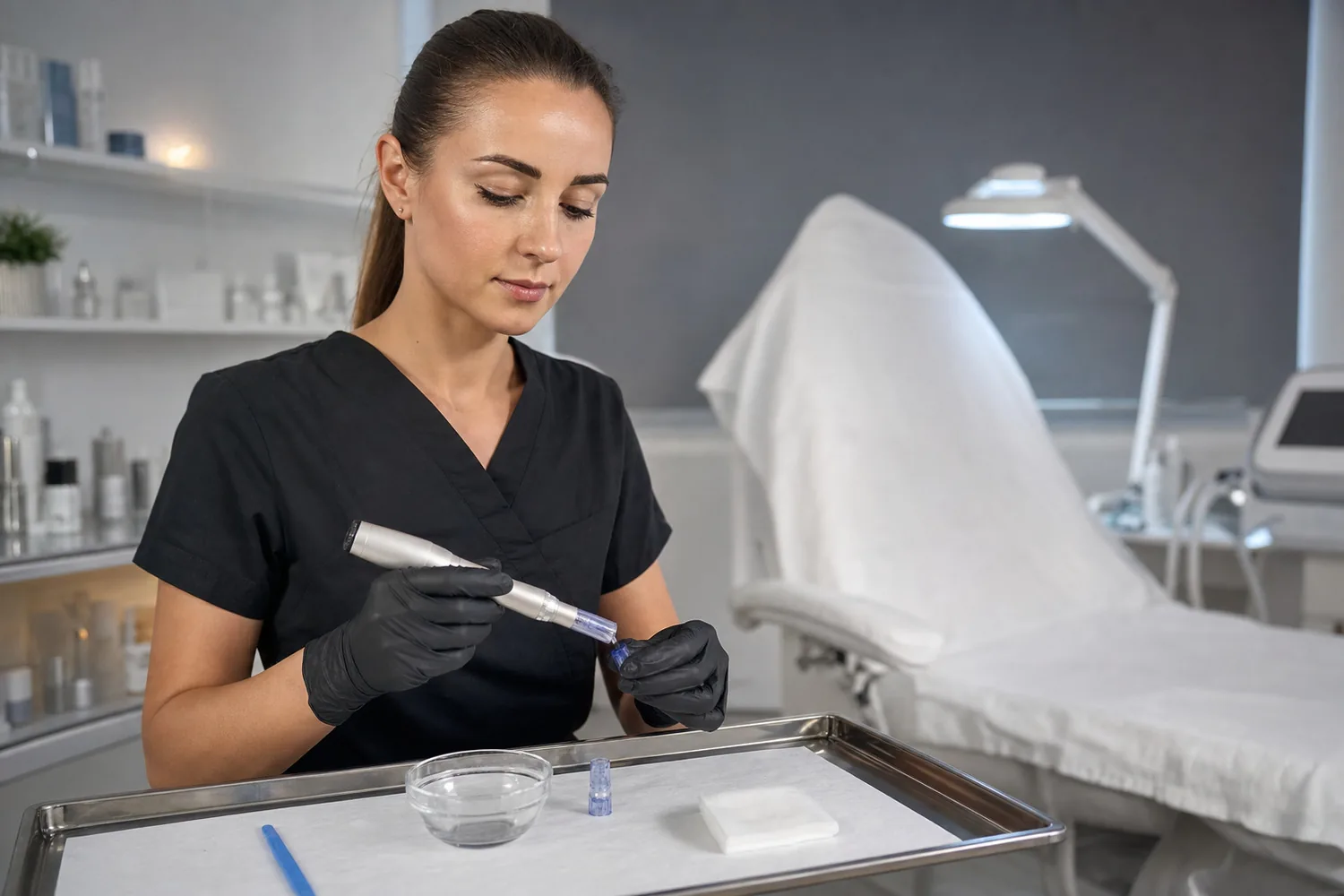
Microneedling treatment setup
Why people come to us

Most people don't Google “microneedling.” They Google their problem.

“How to get rid of acne scars.” “Why my skin looks dull.” “Can anything actually help stretch marks.” At myskiin in Walsall, microneedling — clinically known as Collagen Induction Therapy — is the treatment we reach for when skin has a specific problem that needs addressing from the inside.

Not a facial. Not a temporary glow. A structured course that triggers your skin to rebuild, repair, and resurface itself. The micro-channels created during each session activate your body's own collagen-production response — stimulating real structural change from the dermis up. Whatever your concern, your first step is a free consultation. We'll tell you honestly whether microneedling is the right approach for your skin.

At myskiin, clinical microneedling is delivered by practitioners trained in advanced skin procedures — not a general beauty therapist. We use clinical-grade equipment and carry out a full skin assessment before recommending any treatment plan. We'll be honest about what results are realistic for your specific skin concern and timeline.

Many clients pair microneedling with PRP therapy or refresh skin between courses with HydroFacial O2. We also offer laser hair removal in Walsall. Book a free consultation or read laser on darker skin tones if hair is your main concern.

Book Free Consultation →
🔬

Clinical-grade treatment

Delivered by a qualified specialist with clinical-grade equipment — not a beauty therapist with a home-use device. There's a meaningful difference in depth, safety, and results.

🌱

Stimulates real change

Microneedling triggers your skin's own collagen and elastin production — creating structural improvement that surface treatments can't achieve.

📋

Honest expectations

We tell you what's realistic for your skin, your scar type, and your timeline — at your free consultation, before any treatment begins.

Is this your skin?

Skin concerns microneedling
is clinically suited for

Tell us your concern at your free consultation — we'll tell you what microneedling can realistically do about it.

🕳

Acne scars and pitting

You've cleared your skin but the marks remain — pitting, rolling indentations, boxcar marks. One of the most established uses of microneedling with strong clinical evidence.

Fine lines and loss of firmness

Skin that's changing — losing density, tightness, or the smoothness it used to have. Microneedling stimulates new collagen to restore structure from the dermis up.

🌗

Dark marks and uneven tone

Hyperpigmentation, melasma, or post-acne discolouration. Particularly well-suited to clients with darker skin tones where heat-based treatments carry higher risk.

Large or open pores

Pores that look enlarged or visible — particularly across the nose and cheeks. New collagen formation around the pore walls can help reduce their visible size over a course.

📏

Stretch marks

On the stomach, thighs, arms, or elsewhere. Stretch marks are a type of dermal scar — and microneedling addresses them the same way it addresses acne scars.

🔍

Dull, flat, or tired skin

Not bad skin — just skin that lacks glow and nothing seems to shift it. Microneedling addresses dead cell build-up, declining collagen, and reduced turnover.

📍

Surgical or injury scars

A scar from surgery, an accident, or a historical skin condition. Microneedling breaks down old scar tissue and stimulates more organised collagen in its place.

🌱

Thinning hair or scalp concerns

Hair getting finer, or patches of reduced density. Scalp microneedling — often combined with PRP — may help. Ask about our combined approach at consultation.

Book a free consultation — tell us your concern →
The process

What happens at
your microneedling session

01

Consultation & assessment

Your specialist assesses your skin, reviews your concerns, and sets realistic expectations for your treatment plan. Free, before any sessions begin.

02

Numbing & preparation

A topical numbing cream is applied 30–45 minutes before treatment begins, ensuring the session is comfortable from start to finish.

03

Treatment

The specialist works across the treatment area with the clinical microneedling device — creating controlled micro-channels that trigger the skin's healing response.

04

Aftercare & recovery

Mild redness for 24–48 hours is normal and expected. You'll receive a full aftercare guide. Results build progressively — typically visible after 2–4 weeks.

Treatment programmes

Choose your
microneedling programme

Most skin concerns require a course to see meaningful, lasting results. Your specialist will recommend the right programme for your specific concern. Hover each card to reveal pricing.

Single Session
1
30 min session
hover for price
£250
per session
  • Full clinical microneedling session
  • Skin assessment included
  • Suitable for skin rejuvenation
  • Results visible after 2–4 weeks
Book This →
Course of 6
6
30 min per session
hover for price
£1,000
full course
  • 6 clinical microneedling sessions
  • For deeper scarring or texture concerns
  • Maximum collagen response
  • Best for significant skin improvement
Book This →

Sessions are typically spaced 4–6 weeks apart to allow the skin's healing cycle to complete. Your specialist will build a programme around your skin type and specific concern. Not every concern will respond in the same number of sessions — we will be honest about timelines at your consultation.

All prices subject to confirmation at your free consultation. Package prices not transferable between treatments.

Understanding acne scars

What's actually happening
inside an acne scar

Most people know they have acne scars. Fewer understand why they're so hard to shift — and why microneedling is one of the few treatments with a genuine mechanism against them.

Types of acne scarring — and how microneedling applies

Rolling scars

Broad, wave-like depressions across the cheeks. Caused by fibrous bands tethering the skin to deeper tissue. Microneedling breaks those bands and stimulates collagen to fill the depression.

Boxcar scars

Defined-edge craters on the cheeks or temples. The sharper the edge, the more structured the scar. Deeper boxcar scars may require more sessions, and results take time — your specialist will be honest about this at consultation.

Ice pick scars

Deep, narrow channels extending into the dermis. The most challenging scar type. Microneedling can improve the surrounding skin quality and shallow ice pick appearance, but very deep ice pick scars may benefit from a combined approach discussed at consultation.

Post-inflammatory hyperpigmentation (PIH)

Dark marks left after spots resolve — not technically scars, but often confused with them. These respond to microneedling differently from structural scars. Your specialist will distinguish between the two at your consultation and advise accordingly.

An acne scar forms when inflamed spots damage the dermis — the deeper, structural layer of the skin. When the skin attempts to repair that damage, it doesn't always rebuild perfectly organised collagen. Instead, it lays down collagen in an irregular, disordered pattern — and the surface above it dimples, pits, or scars.

This is why topical creams have limited effect on true scarring. The scar isn't on the surface — it's structural. To address it, you need a treatment that reaches the dermis and triggers the skin to rebuild from within. That's the mechanism behind microneedling.

The micro-channels created by the needles don't just open the surface — they penetrate to the depth your specialist sets, signalling the dermis to respond. That response includes new collagen and elastin production: the same process that heals wounds. Delivered repeatedly in a controlled course, it stimulates a progressive improvement in scar texture, depth, and appearance.

The honest expectation: most clients see meaningful improvement, not complete erasure. Deeper, older scars are the most established — they have years of disorganised collagen reinforcing the structure. A course of microneedling can significantly reduce their appearance and improve the overall texture of your skin. What specifically is achievable for your scars is the conversation we have at your free consultation.

Some clients combine microneedling with PRP therapy for an enhanced regenerative response — applying your own growth-factor-rich plasma immediately after the session to deepen the healing trigger. Your specialist will discuss whether this combination makes sense for your skin at consultation.

Book free consultation →
Questions answered

Microneedling —
your questions answered

Does microneedling hurt?+
A topical numbing cream is applied 30–45 minutes before treatment, which makes the session very manageable for most clients. You may feel a mild scratching or warmth sensation during the treatment. Any discomfort is temporary and significantly reduced by the numbing cream. If you are particularly sensitive, let your specialist know at your consultation and we can discuss the right approach.
How long before I see results?+
Microneedling stimulates a healing process that takes time to show results. Most clients notice improvement in skin quality (texture, glow, hydration) within 2–4 weeks of their first session. For scarring and more significant concerns, meaningful improvement is typically visible after a course of 3–4 sessions. We set realistic expectations at your free consultation.
Is there any downtime?+
Expect redness and mild sensitivity for 24–48 hours after treatment — similar to mild sunburn. This is a normal part of the healing process. Most clients are comfortable returning to daily activities the day after treatment. We provide a full aftercare guide at your session. Avoid heavy makeup, intense exercise, and direct sun exposure for 24–48 hours after treatment.
Will microneedling work on my acne scars?+
Microneedling is clinically recognised as an effective treatment for atrophic (pitted) acne scars — and is one of its most well-established uses. Results depend on the type, depth, and age of your scarring. At your consultation, your specialist will assess your specific scars and give you an honest picture of what improvement is realistic for you over a course of treatment.
Can microneedling be combined with other treatments?+
Yes — some clients at myskiin combine microneedling with PRP (Platelet-Rich Plasma) therapy for an enhanced healing and regenerative response. This combination is popular for acne scarring and skin rejuvenation. Your specialist will discuss whether a combined approach is appropriate for your skin concern at your free consultation.
Where is microneedling available in Walsall?+
Clinical microneedling is offered at myskiin, 19 Lichfield Street, Walsall (WS1 1UG). We're open daily 10am–7pm. Book a free consultation to discuss your skin concerns.
Is the microneedling consultation free?+
Yes — consultations at myskiin are free. We'll assess your skin, explain how microneedling works, and give honest expectations. There's no pressure to book treatment on the day.
Is microneedling suitable for all skin tones?+
Microneedling can be suitable across a wide range of skin tones when performed by a qualified specialist. Pigmentation risk is discussed at your free consultation — we'll confirm suitability before any treatment begins.
How many microneedling sessions do I need?+
It depends entirely on your skin concern. A single session works well for a skin quality refresh or a one-off collagen boost. For acne scarring, pitting, or significant texture concerns, a course of 4–6 sessions is the recommended starting point — results build progressively and we assess progress at every visit. Your specialist will recommend a realistic programme at your free consultation.
What should I avoid after microneedling?+
For the first 24–48 hours after treatment: avoid heavy makeup, intense exercise, direct sun exposure, swimming, saunas, and active skincare ingredients (retinol, AHAs, BHAs). Use only gentle, fragrance-free products and apply SPF daily. The micro-channels created during treatment close quickly, but the skin needs time to complete its healing response. Your specialist provides a full written aftercare guide at your session.
Is microneedling effective for stretch marks?+
Yes — stretch marks are a form of dermal scarring, and microneedling addresses them in the same way it addresses acne scars: by stimulating collagen remodelling within the scar tissue. Results depend on the depth, age, and colour of the marks. Older, white stretch marks tend to be more established and may respond more slowly than newer, redder ones. Your specialist will assess your marks at the free consultation and give an honest picture of what improvement is realistic over a course.

Take the first step

Book your free
microneedling consultation.

Honest expectations. No commitment. Qualified specialist assessment. Open 7 days.

Book Your Free Consultation →

19 Lichfield Street, Walsall · WS1 1UG · 10am–7pm daily

✨ Book Free Consultation
WhatsApp