What the added heat actually does, which scars it suits, what it can’t do, and why it’s often a sensible option for darker skin.
If you’ve had acne scars for years, you’ve probably tried a few things already. Facials that made your skin feel nice for a week. Peels that helped the marks but not the dents. Maybe a course of microneedling that improved the texture, then seemed to stop doing much.
That last one is common, and it’s the main reason people ask us about RF microneedling. This article explains what the “RF” adds, which scars it suits, what it can’t do, and why it’s often a sensible option for darker skin.
The short version: RF microneedling is standard microneedling with controlled heat delivered under the skin’s surface. That heat is what reaches deeper scar tissue. It isn’t right for every scar, and it takes a course, not one session.
Most acne scars that bother people are atrophic: the skin has lost volume and sits lower than the skin around it. They usually fall into three types.
The problem in all three sits in the dermis, the layer under the surface. That’s why skincare alone has limits. Creams and peels work mainly at the surface, and the scar isn’t there.
Standard microneedling creates thousands of tiny, controlled channels in the skin. Your skin treats these as minor wounds and starts its normal repair process, which includes producing new collagen. Over a course of sessions, that collagen can soften texture and shallow scars.
It’s a good treatment. For surface texture, mild scarring and early signs of ageing, it’s often all you need. (Our guide to microneedling covers it in more detail.)
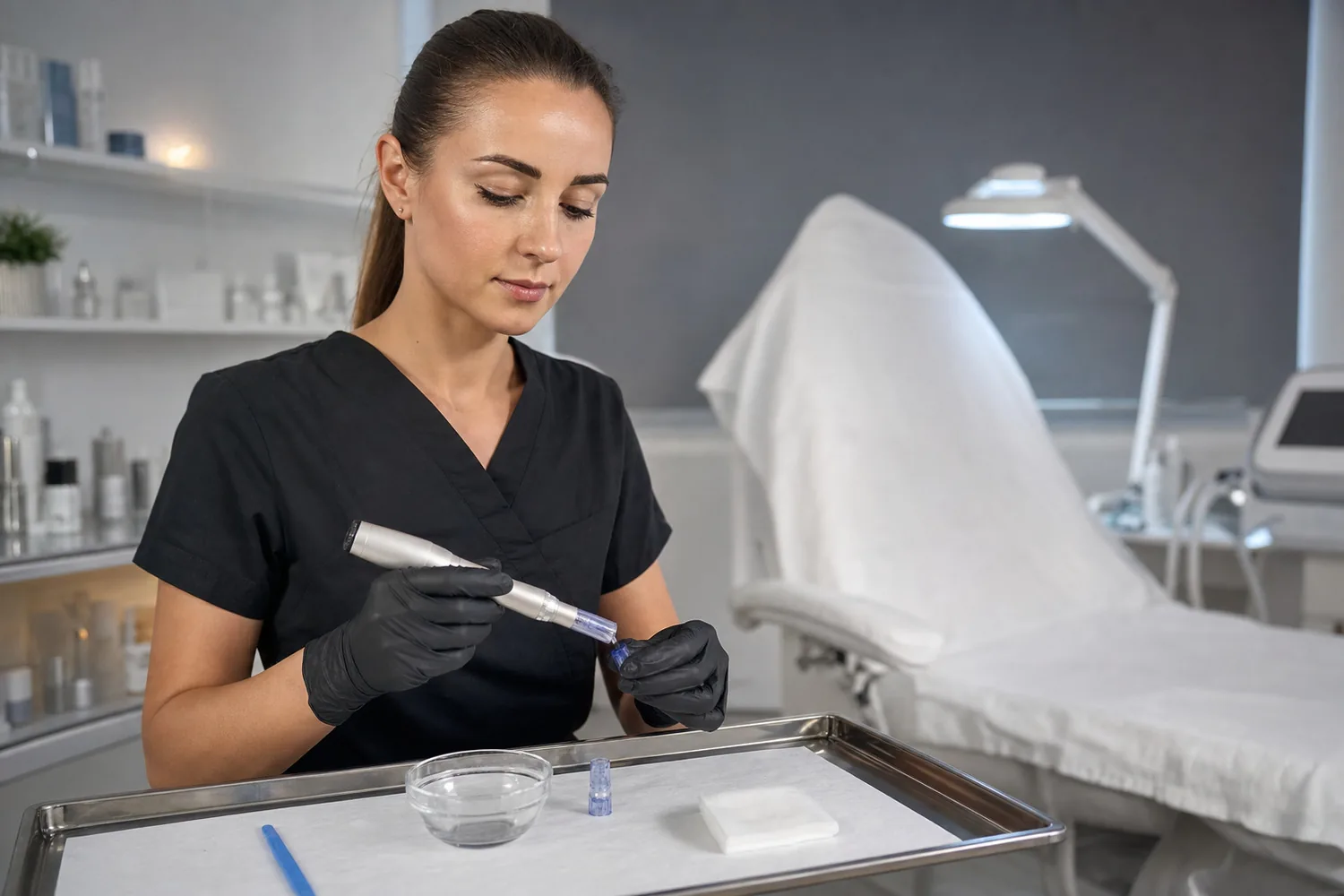
RF stands for radiofrequency. In RF microneedling, the needles deliver radiofrequency energy as heat once they’re under the skin. Many devices use insulated needles, which means the heat comes out mainly at the tip, in the dermis, rather than along the whole needle.
So you get two things at once:
Depth can be set treatment by treatment. That matters for scars, because rolling and boxcar scars sit deeper than the texture problems standard needling handles well.
Published clinical trials of fractional radiofrequency microneedling have reported statistically significant improvement in atrophic acne scars after around three sessions. In several of those studies, the improvement was judged by assessors who didn’t know which patients had been treated, using recognised scar scales. That’s a stronger standard than before-and-after photos picked by a clinic.
Comparisons with standard microneedling are smaller and less conclusive. They suggest RF may give an extra benefit for deeper scars, but the evidence supports “probably helps more for some scars” rather than “always better.”
What the studies don’t tell you is how much your own scars will change. That varies with scar type, depth, how long you’ve had them, your skin and how it heals. Anyone promising a specific result before looking at your skin is guessing.
Generally a good fit: rolling scars and boxcar scars, especially where standard microneedling has plateaued. These have the clearest reason to benefit from the added heat at depth.
Less likely to respond on their own: deep ice-pick scars. They’re narrow and go further down than either method reaches well, so they often need different techniques. We’ll tell you at consultation if we think that’s the case for you.
Not suitable right now: active acne in the area, open wounds, eczema or psoriasis where we’d treat, pregnancy, isotretinoin (Roaccutane) within the last six months, certain implanted devices near the area, and some blood-thinning medications. Active acne needs to be settled first. Treating over it isn’t safe or sensible.
This is where RF microneedling has a genuine advantage, and it’s worth explaining properly.
Some laser resurfacing treatments for scarring heat or remove the outer layer of skin. On Fitzpatrick IV to VI skin (Black, South Asian, many Middle Eastern and mixed skin tones), that surface damage raises the risk of post-inflammatory hyperpigmentation, or PIH: dark marks left behind after the skin has been inflamed. For many people with darker skin, that risk is the reason they’ve been told to avoid laser scar treatment.
Because insulated RF needles deliver most of their heat below the surface, the outer layer takes less of it. That’s why RF microneedling is generally considered a safer option for darker skin than ablative laser resurfacing.
Safer isn’t the same as zero risk. Temporary PIH can still happen on darker skin, so we start with conservative settings, and we may suggest a patch test first. Strict daily SPF before and after your course matters as much as the treatment itself. If pigmentation is your bigger concern than texture, our article on hyperpigmentation and melasma on darker skin is worth reading first.
Expect redness and some swelling for 24 to 72 hours. Some people get small crusts or pinpoint marks that settle within three to five days. Most people plan for around three to five days before they’d feel comfortable with no make-up at a social event. That’s a little longer than standard microneedling, and much shorter than ablative laser.
Studies typically use three sessions, four to six weeks apart. Deeper scarring may need more. Collagen keeps remodelling after your last session, so the full picture tends to show three to six months later. Judge it then, not at week two.
If you’ve had standard microneedling and your scars are still there, or you have darker skin and want a scar option with lower pigmentation risk than laser, it’s worth a conversation.
At your free consultation we’ll look at your scar types, check your skin tone and medical history, and tell you honestly whether RF microneedling, standard microneedling or something else is the better starting point. If it’s the cheaper option, we’ll say so.
---
19 Lichfield Street, Walsall, WS1 1UG · Open every day, 10am–7pm · 01922 929850