Dark marks and patches are not a new problem if you have deeper skin. Honest advice on what actually helps, and what raises your risk of making it worse.
If you have South Asian, Afro-Caribbean, or another darker skin tone, dark marks and patches probably aren’t a new problem for you. What’s harder to find is honest advice on what actually helps, and what makes it worse. So let’s start with the part most clinics skip.
The biggest risk with treating hyperpigmentation on darker skin is triggering more hyperpigmentation. This is called post-inflammatory hyperpigmentation, or PIH, and it is not a rare side effect. It is a real, well-documented risk that any clinic treating Fitzpatrick IV to VI skin needs to plan around, not gloss over.
This article covers what makes hyperpigmentation worse, what the current evidence actually supports, and where a sensible starting point is.
Not all dark marks are the same thing, and the difference matters for treatment.
Melasma is hormonal, driven by oestrogen, progesterone, and UV exposure. It shows up as brown or greyish patches, usually on the cheeks, forehead, and upper lip. It’s common in darker skin and tends to recur.
Post-inflammatory hyperpigmentation (PIH) happens after the skin has been through some kind of trauma or inflammation, acne, a burn, a cosmetic procedure, an injury. Melanocytes respond to that inflammation by producing extra pigment, leaving a dark mark behind. It can affect any skin tone but is more pronounced and slower to fade in darker skin, because of higher baseline melanin density.
Solar lentigines, or sun spots, are flat brown marks caused by cumulative UV exposure, usually seen more in older patients.
Getting the type right matters because the wrong treatment for the wrong type of pigmentation can make things worse, which brings us to the part that actually protects you.
This is the section that matters most, so we’re not burying it.
Combination laser and topical treatment carries a meaningfully higher risk of adverse events than topical treatment alone. A 2026 systematic review and meta-analysis of 11 randomised controlled trials and 461 patients found the risk of adverse events with combination laser plus topical therapy was significantly higher than with topical treatment by itself. The most common adverse events recorded were redness, post-inflammatory hyperpigmentation, a burning sensation, itching, and skin flaking.
That finding is the whole reason this article exists. If you have Fitzpatrick IV to VI skin and a clinic offers you laser for pigmentation without discussing PIH risk at all, that’s a red flag, not reassurance.
What raises your PIH risk specifically:
What lowers the risk, when treatment is appropriate:
We’re not going to promise you clear skin. Here’s what published research supports instead.
A systematic review of 11 clinical trials found combination treatment for melasma produces meaningful, progressive improvement, with significant reductions in pigmentation scores from 8 weeks onwards. Results build over time: early sessions lay the groundwork, and the same review found no significant benefit yet at 4 weeks. If you start a course of treatment for melasma, don’t judge it at week two.
A separate systematic review of 16 clinical trials and 471 patients found laser therapy alone produced a moderate to large improvement in pigmentation scores on average, with overall patient satisfaction of around 66%. Satisfaction varied a lot between studies, and the biggest single reason was which laser was used: some wavelengths perform well on melasma and others perform poorly on it. That is the honest answer to "will this definitely work for me." It depends on the type of pigmentation you have, whether the right modality is chosen for it, and your individual skin. It is also why we will not recommend a laser for pigmentation without assessing it first.
Melasma also comes back. Published recurrence rates range from around 44% at 12 weeks to around 50% at 6 months without ongoing photoprotection, with lower recurrence reported for some picosecond laser protocols. This is a chronic, hormonally driven condition. Sun protection and maintenance aren’t optional extras, they’re what keeps a result from reversing.
Given the PIH risk with laser and topical combination treatment, a lower-risk starting point is usually the right approach for Fitzpatrick IV to VI skin, especially if you haven’t tried anything before.
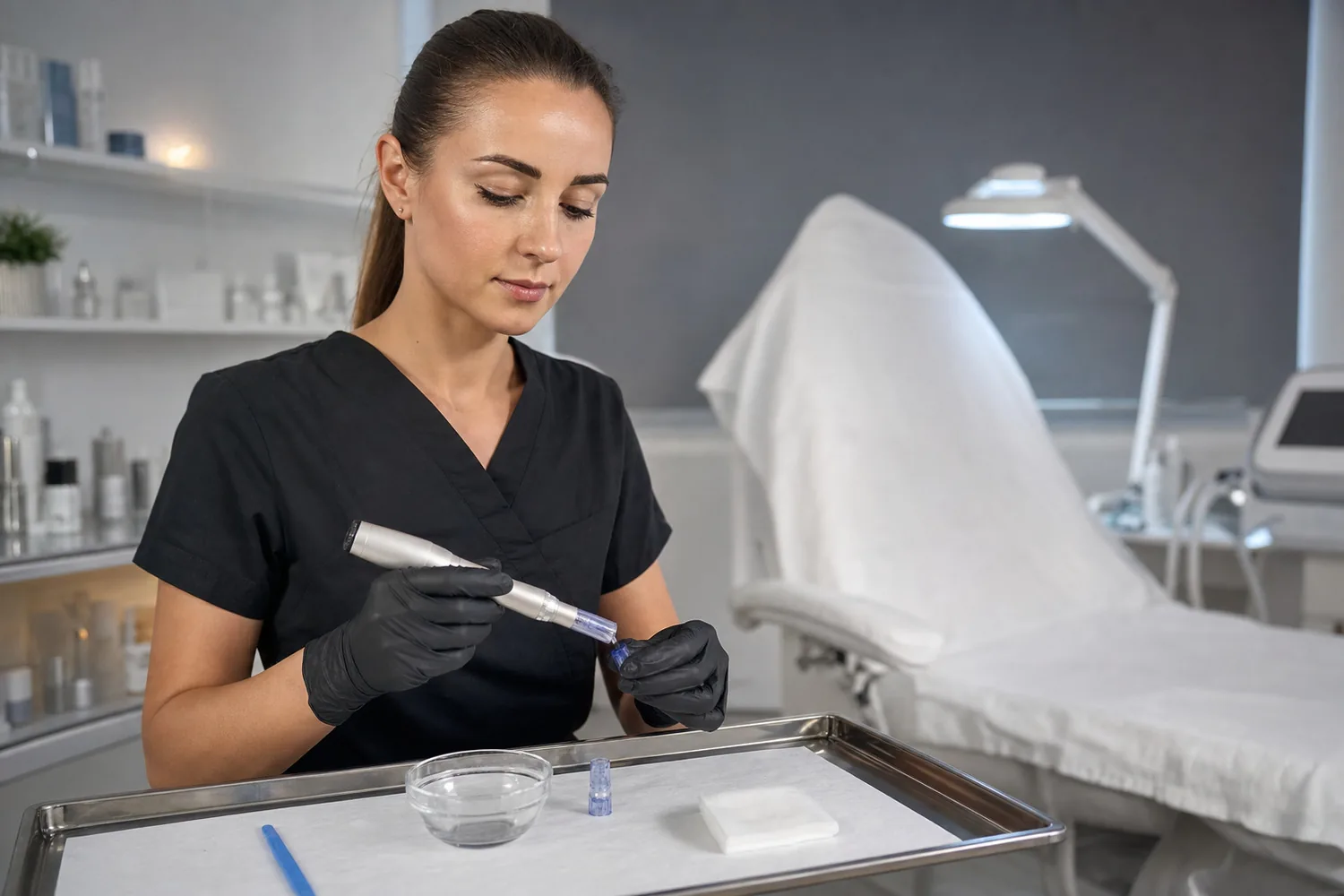
Microneedling, used to help deliver active ingredients like vitamin C, azelaic acid, or tranexamic acid into the skin, is a gentler mechanical approach without the thermal risk that laser carries. It’s a reasonable first step for melasma or PIH on darker skin, and one worth discussing before anything more intensive.
Microdermabrasion is a similarly low-heat, low-risk option for general uneven tone and works well as an entry point if you’re nervous about pigmentation risk.
HydroFacial with vitamin C and vitamin E infusion is appropriate for milder concerns and carries no PIH risk of its own.
If laser is genuinely the right tool for your specific pigmentation, at myskiin we’d talk you through fluence, session spacing, and topical support first, and we’d tell you plainly if we think a gentler approach should come first instead.
If you want to support your skin at home alongside anything you do in clinic, the ingredients with the best evidence for darker skin specifically are azelaic acid and niacinamide. Both are associated with lower PIH risk than some stronger alternatives like hydroquinone, which still has a place in treatment but needs closer supervision on darker skin. Vitamin C, kojic acid, and tranexamic acid also appear repeatedly in the research as useful adjuncts. None of this replaces daily SPF, which is the single most important habit for keeping any of these results in place.
If you’ve been putting up with dark marks because you weren’t sure what was safe for your skin tone, or because a previous experience somewhere else made things worse instead of better, we understand why you’d be cautious. That caution is reasonable, and a proper consultation should answer it rather than dismiss it.
At your free consultation we’ll look at exactly what type of pigmentation you’re dealing with, talk through the realistic timeline, and recommend the option with the right balance of effectiveness and risk for your skin, starting conservative where that’s the sensible call.
19 Lichfield Street, Walsall, WS1 1UG · Open every day, 10am–7pm · 01922 929850