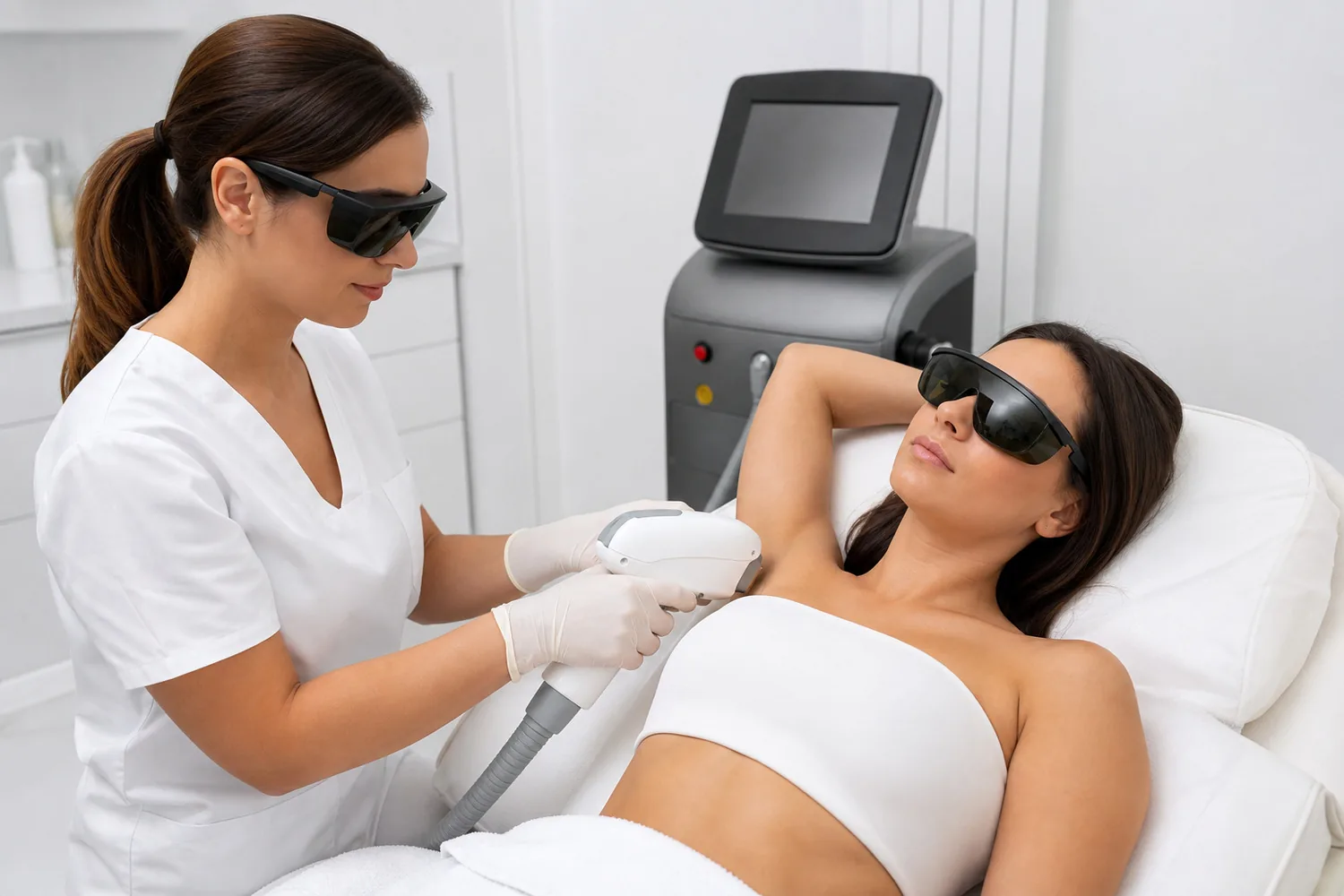
Autumn and winter are often the easiest time to start a laser course, because avoiding a tan is simpler. Here is the honest reason why, and how to work out when to begin.
If you have a date in mind next year, the honest answer is that you start in autumn or winter. Not because of an offer, and not to rush you. It is about how the treatment actually works.
There are two reasons, and both come down to the calendar rather than the machine.
Laser hair removal works by targeting the pigment in the hair. Recently tanned skin has more pigment near the surface, which makes treatment less comfortable and raises the risk of a reaction such as temporary lightening or darkening of the skin. For that reason, most clinics ask you to keep the treatment area out of direct sun, and off sunbeds and fake tan, for a set period before each session (often several weeks), and to protect it carefully afterwards.
In practice that means summer is the hardest time of year to run a course properly. You are treating through the sunniest months, working around holidays, and reapplying SPF constantly. Autumn and winter remove that friction. The areas people most often treat, such as legs, underarms and the bikini line, are covered up anyway, and there is far less chance of a session being postponed because of recent sun.
A course is usually six to eight sessions for most areas, and sessions are spaced four to eight weeks apart depending on the area, so each one catches a fresh wave of follicles in the active growth phase of the hair cycle. Facial areas tend to sit at the shorter end, around four to six weeks, and body areas at the longer end, around six to eight. We explain how this works in more detail in our guide to how many sessions laser hair removal takes.
Add it up and a full course runs anywhere from about five months to a year or more, depending on the area and how your hair responds, and some people need occasional maintenance sessions afterwards. So whatever you begin in spring is still going when you actually wanted it finished. Starting in autumn or winter means most of the course runs in the months when sun isn't in the way, and you're well into it by the following summer.
Here is what a course on a body area such as the legs or underarms could look like if you start in December, with sessions about eight weeks apart. Your own spacing is set at your consultation.
| Session | Roughly when |
|---|---|
| Patch test and consultation | Late November or early December |
| Session 1 | December |
| Session 2 | February |
| Session 3 | April |
| Session 4 | June |
| Further sessions, if needed | Summer and autumn, planned around holidays and sun exposure |
In this example that's four sessions by June: about half of an eight-session course, or two thirds of a six-session one. It isn't the end of the course, but it's still a very different position from starting in May. Facial areas, with shorter gaps, move through their sessions faster. And if you start in January instead, the same pattern simply shifts by a month.
Work backwards from when you want to see the benefit, and give the course a generous runway.
| Your target date | Sensible time to start |
|---|---|
| Next summer | September to December |
| A spring holiday or wedding | The previous autumn |
| A winter trip | Around six to nine months before |
| No fixed date, just want to begin | Any time, and autumn or winter is the easiest run |
These are guidelines, not promises. Laser hair removal aims for long-term reduction rather than removal, and maintenance sessions may be needed. Your hair colour and thickness, your skin tone, the area, and hormonal factors all affect how a course progresses, which is why the estimate you get at a consultation is specific to you rather than a general figure.
Yes, with a bit more care. It is not off limits, but there are a few things to know:
If you are already mid-course when summer arrives, you can usually carry on as long as the area hasn't been tanned. A session sometimes has to move because of a holiday or recent sun, so stay strict with sun protection.
If it is late autumn or winter as you read this, the timing is on your side. You have the cooler months to get the first sessions done, and the areas most people treat are under clothes anyway. Starting now is the difference between being well into your course by next summer and only just beginning.
Worth knowing: there is no single "laser season", and you can start a course at any time of year. Autumn and winter are simply the run with the fewest obstacles, because sun exposure is the most common reason a session gets postponed.
The useful version of "when should I start" is the one worked out for your hair, your skin and the areas you want to treat. That is what a consultation is for. It is free, there is no charge for the patch test, and you don't have to book anything on the day.
We will look at your skin and hair, give you a realistic view of how many sessions your areas are likely to need and over what timeframe, and you decide from there.
19 Lichfield Street, Walsall, WS1 1UG · Open every day, 10am to 7pm · 01922 929850