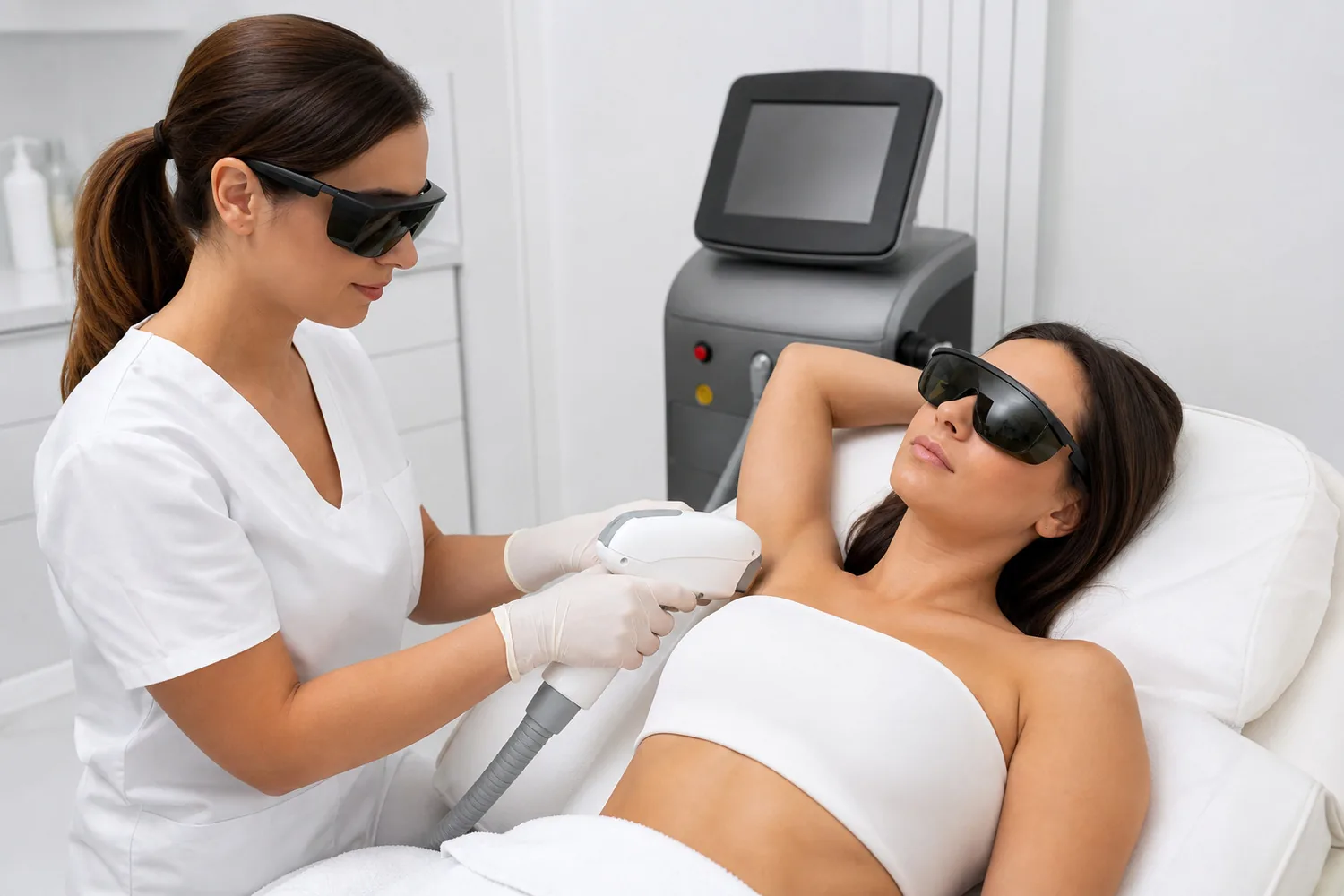
The honest answer depends on your area, hair type, and skin tone. Here’s a practical guide — from a clinic that does it every week.
This is one of the first questions people ask — and understandably so. You want to know what you’re committing to before you book.
The honest answer: it varies. But it varies in predictable ways, and we can give you a realistic estimate at your free consultation once we’ve seen your skin and hair type. Here’s what you need to know.
Laser hair removal works by targeting hair follicles during the active growth phase of the hair cycle — called the anagen phase. At any given time, only a proportion of your hair is in this phase. The rest is resting or shedding.
This is why you can’t do it in one session. Each treatment targets the hair that’s currently active. Sessions are spaced weeks apart to catch successive waves of follicles entering the growth phase. Over a course, the cumulative effect on the follicles leads to lasting reduction.
These are general guidelines. Your specialist will give you a more specific estimate at your consultation based on your hair and skin.
| Area | Typical sessions | Spacing |
|---|---|---|
| Underarms | 6–8 | Every 4–6 weeks |
| Bikini / Hollywood | 6–8 | Every 4–6 weeks |
| Upper lip | 6–10 | Every 4 weeks |
| Chin / lower face | 6–10 | Every 4 weeks |
| Legs (half or full) | 6–8 | Every 6–8 weeks |
| Back / chest | 6–8 | Every 6–8 weeks |
| Full body | 8–10 | Every 6–8 weeks |
Facial areas tend to need more sessions and shorter spacing because facial hair cycles are faster. Body areas have longer growth cycles and are typically spaced further apart.
Several factors affect how many sessions you’ll need:
Hair colour and thickness. Darker, coarser hair responds best to laser. Fine or light-coloured hair is harder to target precisely — we discuss this honestly at consultation.
Skin tone. The Soprano system we use at myskiin is designed to work across a wide range of skin tones, including darker and melanin-rich skin. Settings are adjusted individually.
The area being treated. As the table above shows, the face needs more sessions than most body areas. Hormonal areas (chin, upper lip) may also need more.
Hormonal factors. Clients with PCOS or other hormonal conditions that drive ongoing hair growth often need additional sessions and may benefit from periodic maintenance treatments. We cover this in our laser hair removal and PCOS guide.
Your individual response. Some clients see dramatic reduction after five sessions; others need the full eight or slightly beyond. Your specialist reviews progress at every session.
After completing a course, most clients find hair in the treated areas is significantly reduced — often to the point where regular shaving or waxing becomes unnecessary. Some hair may regrow finer and lighter over time; occasional maintenance sessions (typically once a year or less) can address this.
This is why we talk about “long-lasting reduction” rather than permanent removal — because for the majority of clients, that’s what it delivers. What it looks like for you specifically is a conversation for your consultation.
Results vary. The figures in this article are general ranges. Your specific session count depends on your hair type, skin tone, treatment area, and hormonal factors. Your specialist will give you an honest estimate at your free consultation.
The best way to know how many sessions your areas need is to book a free consultation. We assess your skin type, hair colour and thickness, and the areas you want to treat — and give you a realistic session estimate before you commit to anything.
19 Lichfield Street, Walsall, WS1 1UG · Open every day, 10am–7pm · 01922 929850