Fat freezing sounds like it works brilliantly in marketing and less so in practice. Here’s the honest answer — including what it can and cannot do, and who gets the most from it.
Fat freezing (cryolipolysis) is a reasonable thing to be sceptical about. Here’s the honest answer: it does work, for the right people, with realistic expectations about what it can and cannot do.
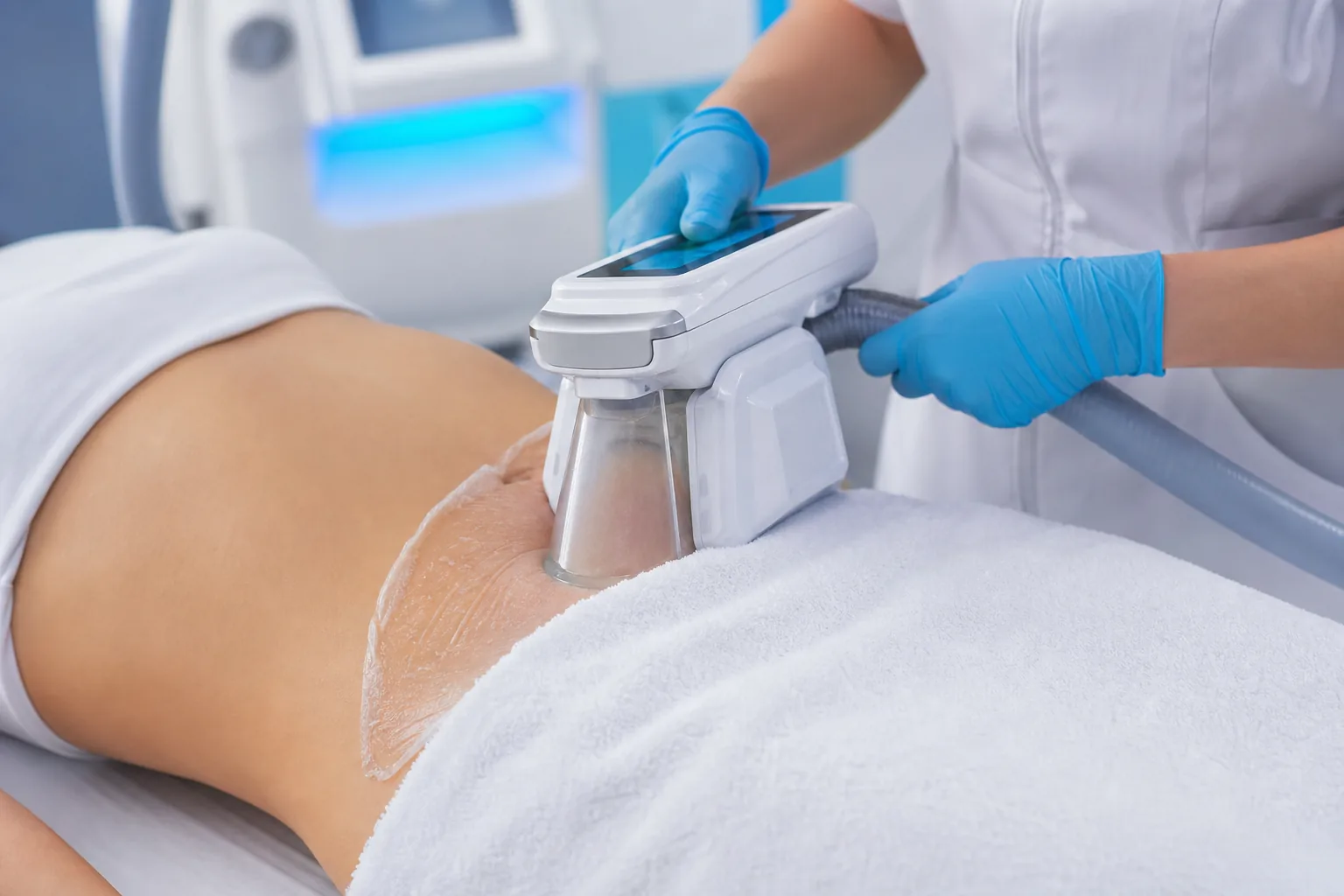
A handpiece is applied to the treatment area using gentle suction. The device reduces the temperature of the underlying tissue to the point where fat cells are affected, while surrounding skin, muscle, and tissue remain unharmed. Fat cells are more vulnerable to cold temperatures than other cell types — at the temperature used in cryolipolysis, they are progressively damaged and die. The body’s lymphatic system then processes and eliminates them over the following weeks. The fat cells that are eliminated don’t come back.
This is a body contouring treatment — it reshapes specific areas, not overall weight. It’s best suited to people at a stable, healthy weight with localised fat pockets — a lower abdomen, love handles, inner thighs — that don’t shift despite diet and exercise.
Results are gradual. Most clients begin to notice a change from around six weeks after treatment, with the clearest result visible at the three-month mark as the body finishes processing eliminated fat cells.
At myskiin: abdomen, flanks (love handles), inner and outer thighs, arms, bra-line area. Multiple areas can be treated in the same session.
For the right client — someone with a specific, stable stubborn fat pocket and realistic expectations — fat freezing can make a genuine, lasting difference without surgery, anaesthesia, or recovery time.
19 Lichfield Street, Walsall, WS1 1UG · Open every day, 10am–7pm · 01922 929850