Fat freezing is cryolipolysis, and it’s only one kind of cryotherapy. “Cryotherapy” just means treatment with cold, and in Walsall the word covers three very different things: fat freezing (cryolipolysis) for a stubborn pocket of fat, whole-body cryo chambers you stand in for a few minutes, and freezing a skin tag or wart with liquid nitrogen. They use cold in different ways, for different reasons, and they’re done by different people. Here’s how to tell which one you’re looking for.
The short version
| Fat freezing (cryolipolysis) | Whole-body cryotherapy | Skin lesion freezing | |
|---|---|---|---|
| What it is | A cooling applicator on one area of fat | Standing in a very cold chamber for a few minutes | Liquid nitrogen applied to a single spot |
| What it’s for | A localised pocket of fat (body contouring) | Mostly wellness and sports recovery | Warts, skin tags and some other skin lesions |
| Who usually offers it | Aesthetic clinics | Cryo centres, gyms, spas | GPs, NHS dermatology, some pharmacies and private clinics |
| How long a session takes | 35 to 60 minutes per area | A few minutes | Seconds per spot |
| At myskiin | Yes | No | No |
Fat freezing (cryolipolysis)
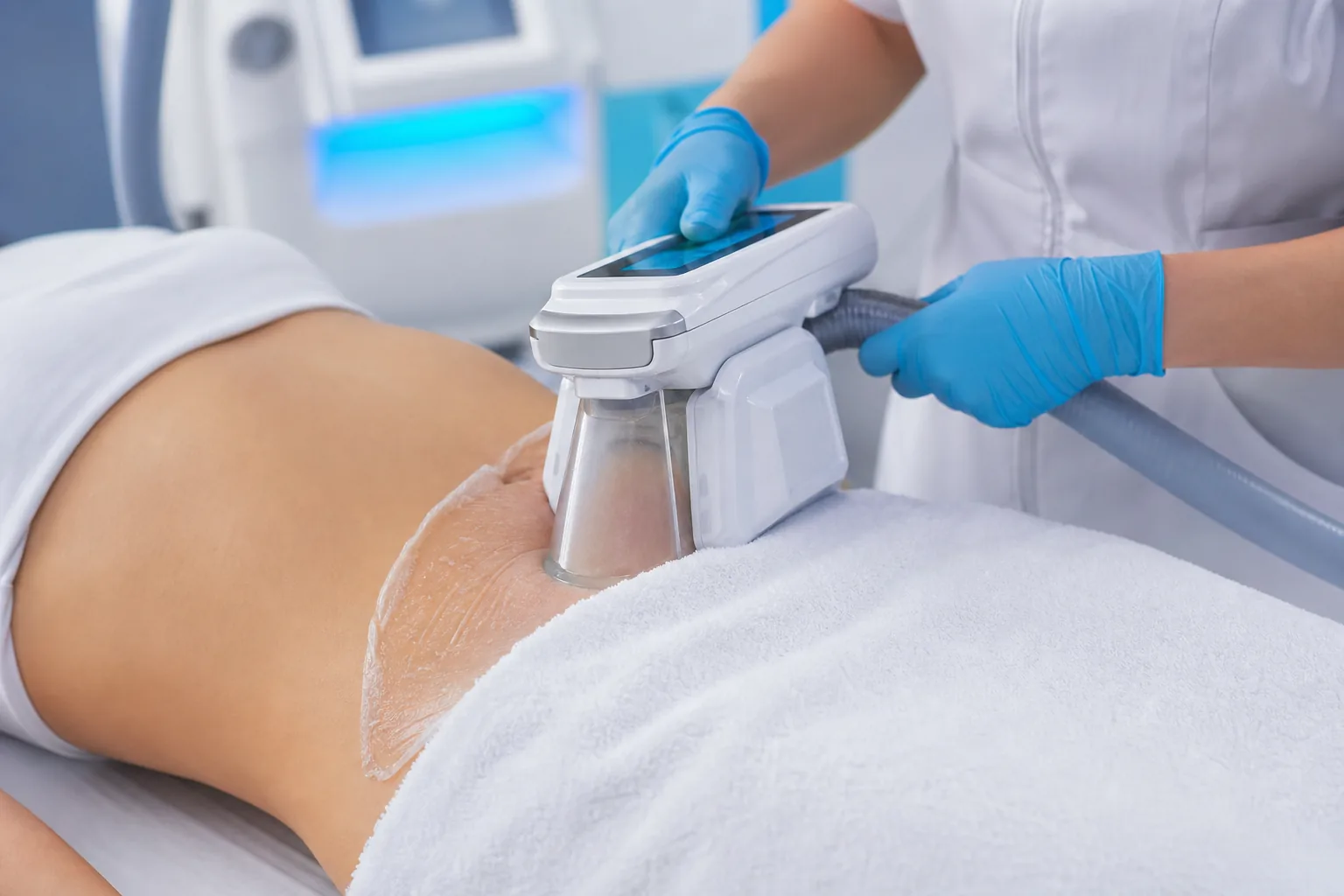
This is the one people often mean when they say “cryotherapy” at a skin and body clinic. A cooling applicator is placed on an area such as the lower stomach, flanks, thighs or bra line. Fat cells are more sensitive to cold than the skin and muscle around them, so controlled cooling is designed to damage the fat cells in that area. The body then gradually clears the damaged cells.
A few things are worth knowing before you book anywhere:
- It’s body contouring, not weight loss. It may reduce a localised bulge of fat, and whether it suits you needs an assessment first. It won’t change your weight, and the fat cells left in the area can still get bigger if you gain weight later.
- Changes are gradual. They develop over weeks, not days. Our guide to whether fat freezing works covers results and timing in detail.
- It feels cold, then numb. You’ll feel cold and some pulling at first, then the area goes numb. Afterwards, temporary redness, bruising, swelling and pain can occur, and altered sensation or numbness may last for a few weeks.
- There’s a rare side effect you should hear about. It’s called paradoxical adipose hyperplasia (PAH): the treated fat gets larger instead of smaller, usually showing two to five months later. It doesn’t go away on its own and may need surgery to correct. A 2025 review of the published studies estimated it at about 0.22% of people treated, roughly 1 in 455, while noting the evidence is low certainty. Estimates vary between studies, depending on follow-up and on whether people or treatment sessions are counted.
- It isn’t for everyone. Some cold-sensitive conditions rule it out, including cryoglobulinaemia, cold agglutinin disease, paroxysmal cold haemoglobinuria, cold urticaria, Raynaud’s and chilblains. So does poor circulation in the area, and it shouldn’t be used over or near a hernia. We don’t offer fat freezing during pregnancy, so we wait until afterwards. Breastfeeding and your wider medical history are discussed at your consultation.
Whole-body cryotherapy (cryo chambers)
Whole-body cryotherapy means stepping into a chamber or cabin filled with extremely cold air or vapour for a few minutes. It’s popular with athletes and wellness centres, and you’ll see claims about recovery, pain, sleep and skin.
The evidence for most of those claims is limited. In 2016 the US Food and Drug Administration warned that no whole-body cryotherapy device had been cleared or approved to treat any medical condition. It also listed the risks: frostbite, burns, eye injury and, where nitrogen vapour is used, a lack of oxygen.
Some people enjoy it as a wellness experience, and that’s their call. If you have a medical condition such as joint pain or arthritis, speak to your GP rather than relying on a cryo chamber to treat it. We don’t offer whole-body cryotherapy at myskiin.
You may also see “cryo facials” or “cryo slimming” on menus. These names describe cold applied to the face or body in different ways, so ask the provider exactly what the treatment involves and what evidence sits behind it.
Freezing skin lesions (dermatological cryotherapy)
This is how dermatology uses cryotherapy. A very cold substance, usually liquid nitrogen, is applied to a single spot such as a wart, a verruca, a skin tag, or sun-damage patches a doctor has diagnosed as actinic keratoses. The cold destroys that small area of skin, which usually heals over the following weeks.
In the UK this is offered by GPs, NHS dermatology services, some pharmacies and private skin clinics. Availability on the NHS varies by area. For warts and verrucas, your local pharmacist is a sensible first stop. The NHS doesn’t remove skin tags, as it counts as cosmetic, so it’s a private treatment.
One important point: any skin mark you’re unsure about should be assessed before it’s frozen. A mole or mark that’s changing in size, shape or colour, bleeding or itching needs checking by your GP first. We don’t offer lesion freezing at myskiin.
Which one are you looking for?
- A stubborn pocket of fat that won’t shift with diet and exercise: fat freezing (cryolipolysis) may be worth asking about. That’s the one we offer, and suitability is checked at a free consultation.
- Recovery after training, or a wellness experience: whole-body cryotherapy at a cryo centre. For pain or a medical condition, see your GP first.
- A wart or verruca: start with your pharmacist or GP. For a skin tag, get it assessed first; removal is private. Get any changing mole checked by your GP.
Fat freezing at our Walsall clinic
Every fat freezing treatment at myskiin starts with a free consultation at our clinic on Lichfield Street in Walsall town centre. We look at the area, check your medical history and skin, and talk through whether fat freezing suits you, how many sessions might make sense and the rare risks, including PAH. If it isn’t the right fit, we’ll say so. Sometimes another approach suits the area better, such as skin tightening where loose skin is the bigger concern.
See how fat freezing works at our Walsall clinic, or book a free consultation.
19 Lichfield Street, Walsall, WS1 1UG · Open every day, 10am to 7pm · 01922 929850